


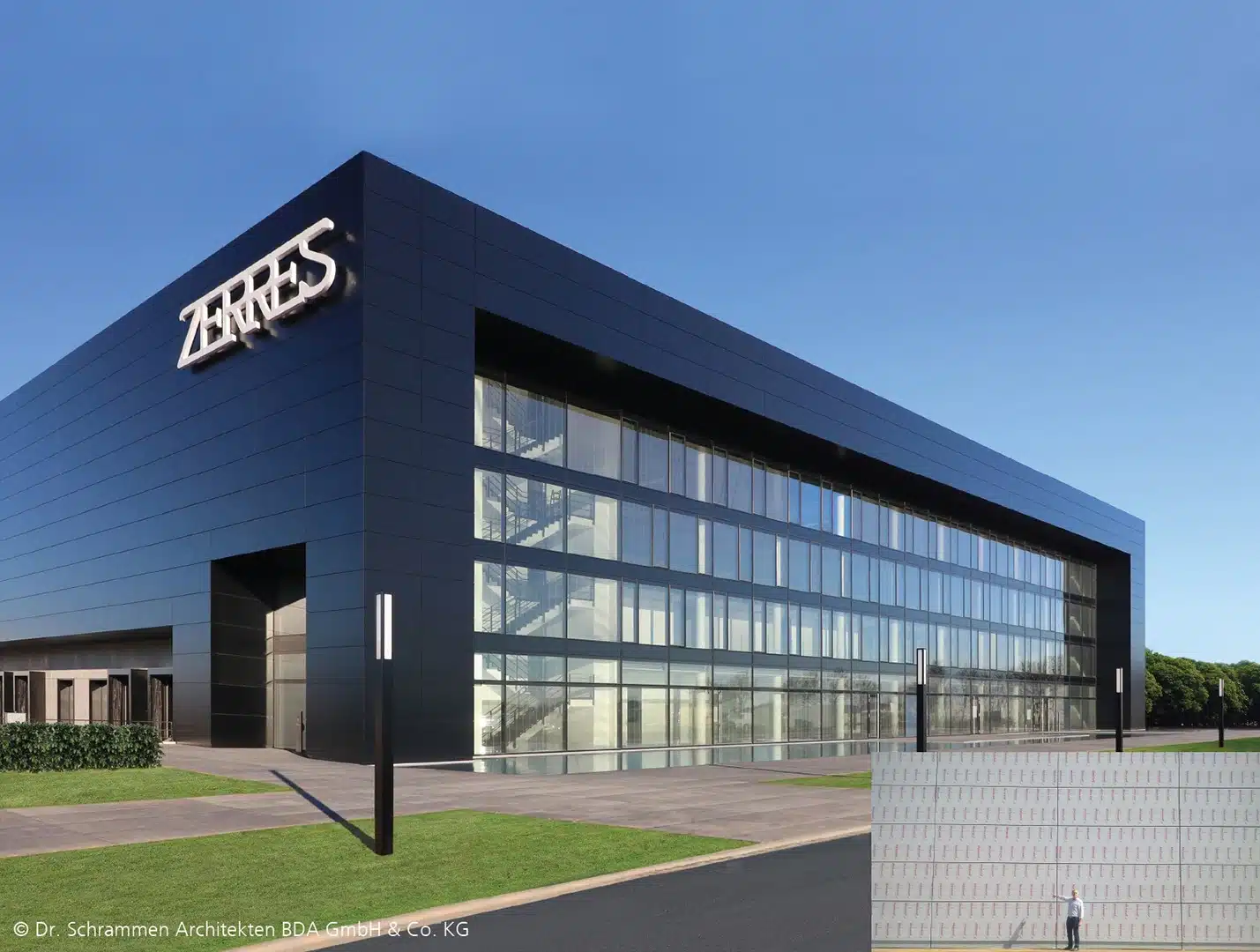
Outstanding flatness even with large formats
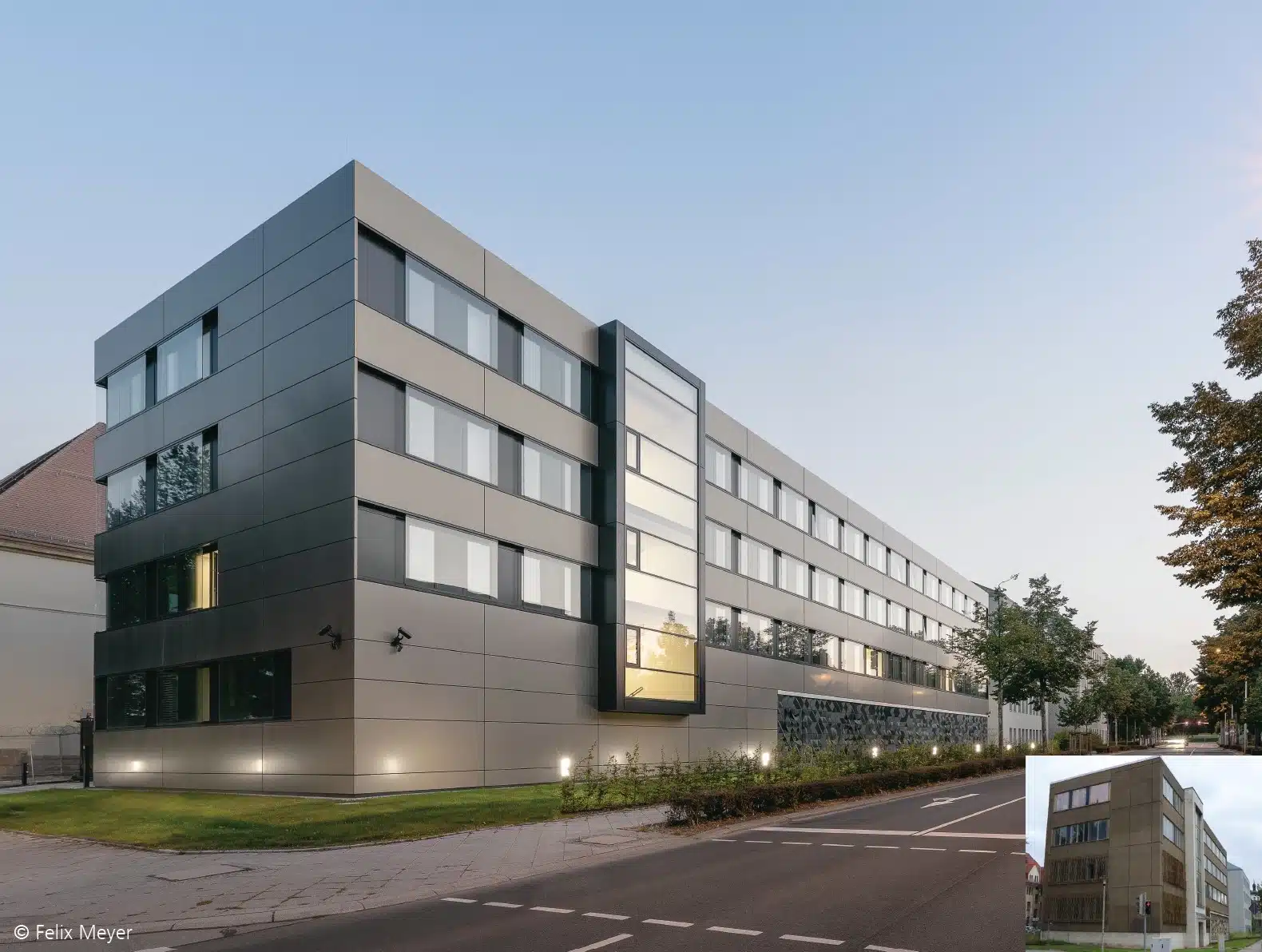
High stiffness & low product weight
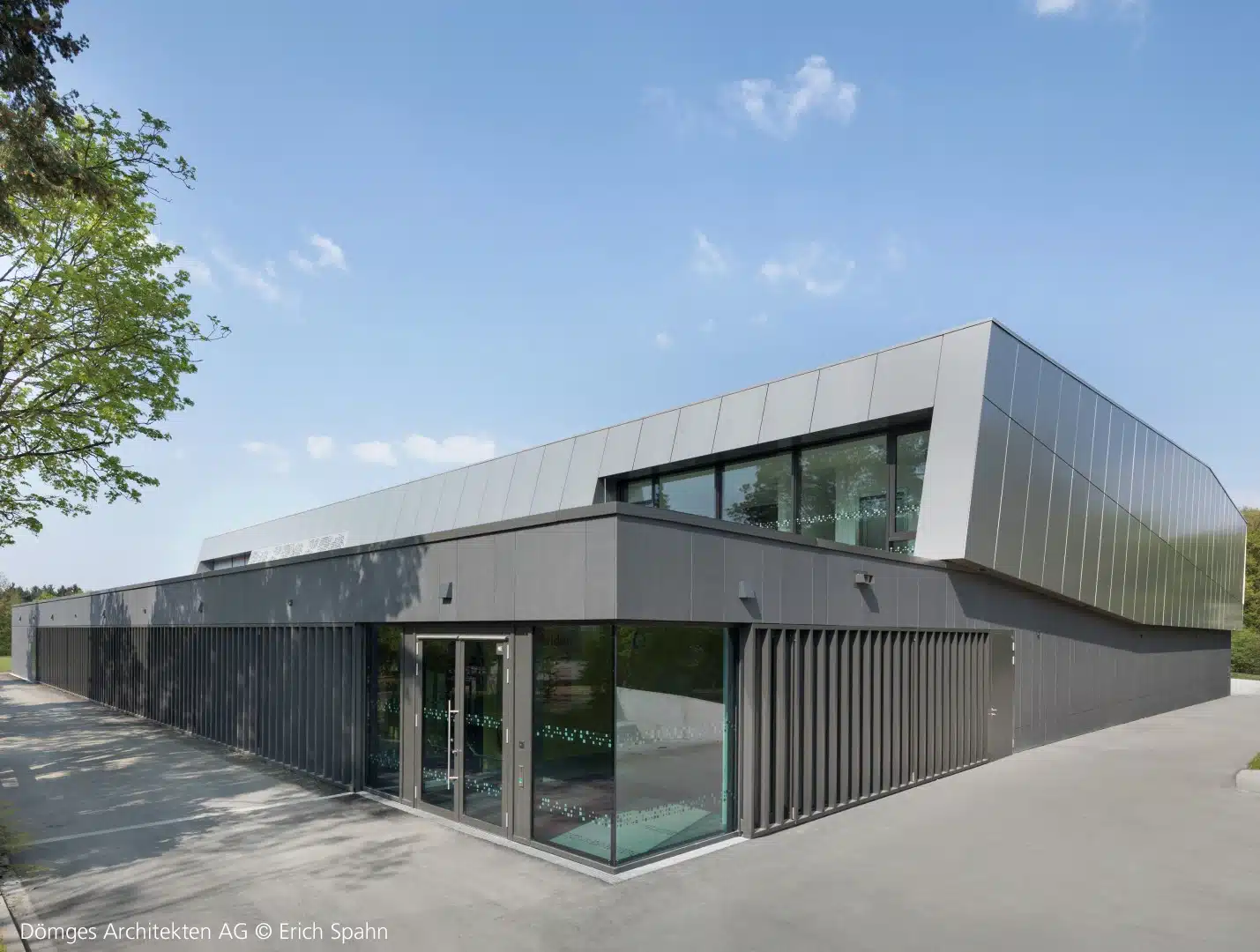
Simple processing & installation
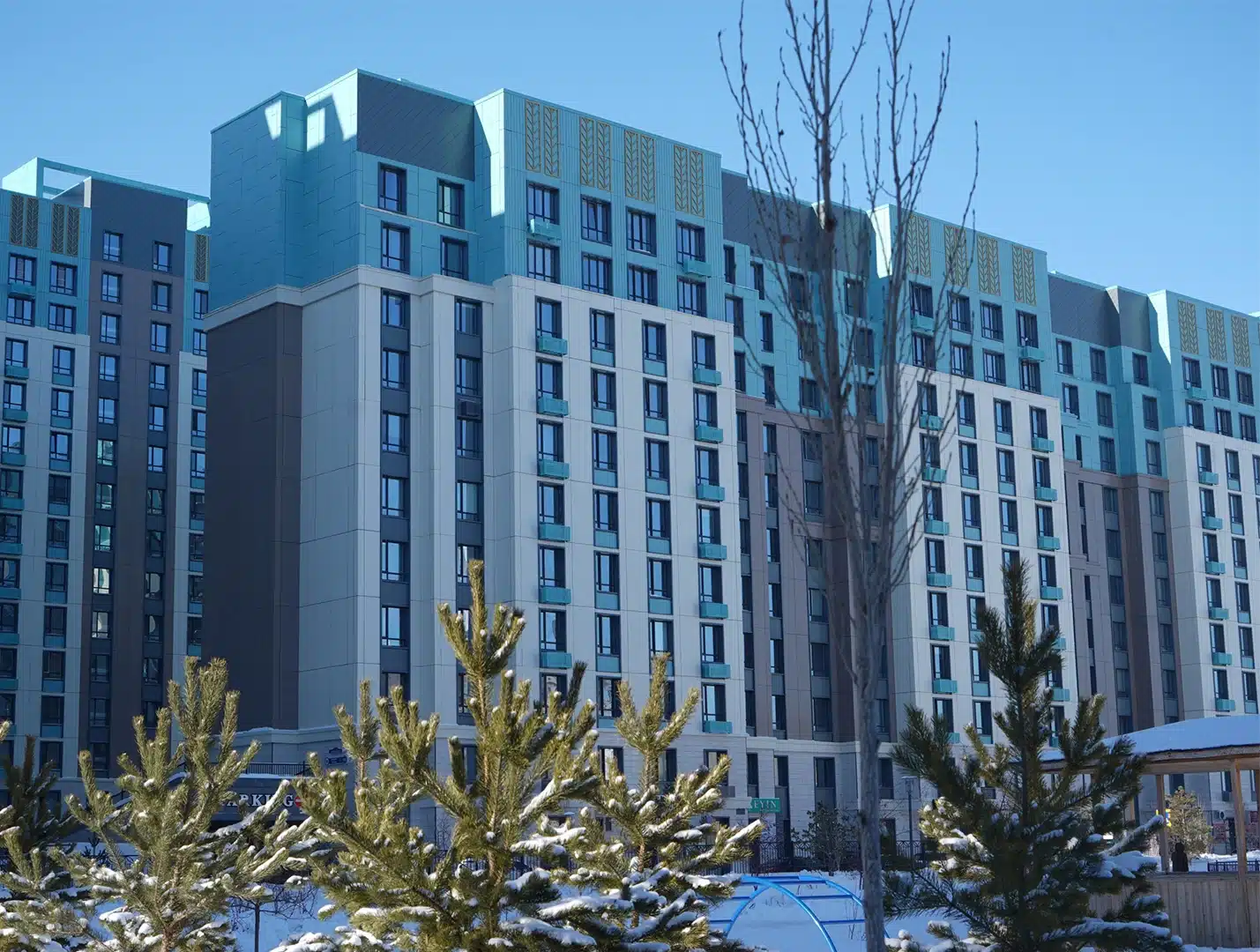
Durable & corrosion-resistant
Metawall® lightweight panel for cladding – Lightweight, stable, economical
Metawall® is an extremely lightweight yet rigid aluminium lightweight panel – ideal for cladding. Thanks to the clever structure with an aluminium corrugated core, even large-area elements are flat, dimensionally stable and allow large spans. This reduces the need for a substructure and makes installation faster and more economical. Metawall® consists entirely of aluminium (approx. 80% secondary aluminium), is corrosion-resistant and 100% recyclable without material separation. For cladding we offer the products Metawall® B1 and Metawall® A2.

Areas of application for Metawall®
Versatile and efficient
Metawall® lightweight panels offer outstanding benefits in a wide range of building projects, from renovation and refurbishment to energy-efficient new builds. Thanks to their flexibility, durability and outstanding technical properties, they are the ideal choice for a wide range of applications.
Renovation & refurbishment
Metawall® is ideal for the renovation and refurbishment of existing buildings – especially where creative facade solutions are required.
Advantages in renovation:
- Low weight: Unbeatable 5.2 kg/m² – ideal for statically limited load-bearing reserves
- Quick and easy installation: For short construction times and rapid reuse of buildings
- Aesthetic variety: Individual color and surface options allow perfect adaptation to existing architecture
Energy efficient new builds
Metawall® is the perfect choice for energy-efficient new buildings. In combination with modern thermal insulation, the result is a durable, sustainable facade solution that fulfils the highest technical and aesthetic requirements.
Advantages for new builds:
- Sustainability: Metawall® consists of approx. 80% secondary aluminium and is 100% recyclable without prior material separation
- Environmental Product Declaration: EPD available – for sustainable building certifications like Leeds, DGNB, etc.
- Durability: The robust surface and excellent corrosion protection guarantee a long service life for the facade
Medium and large-scale projects
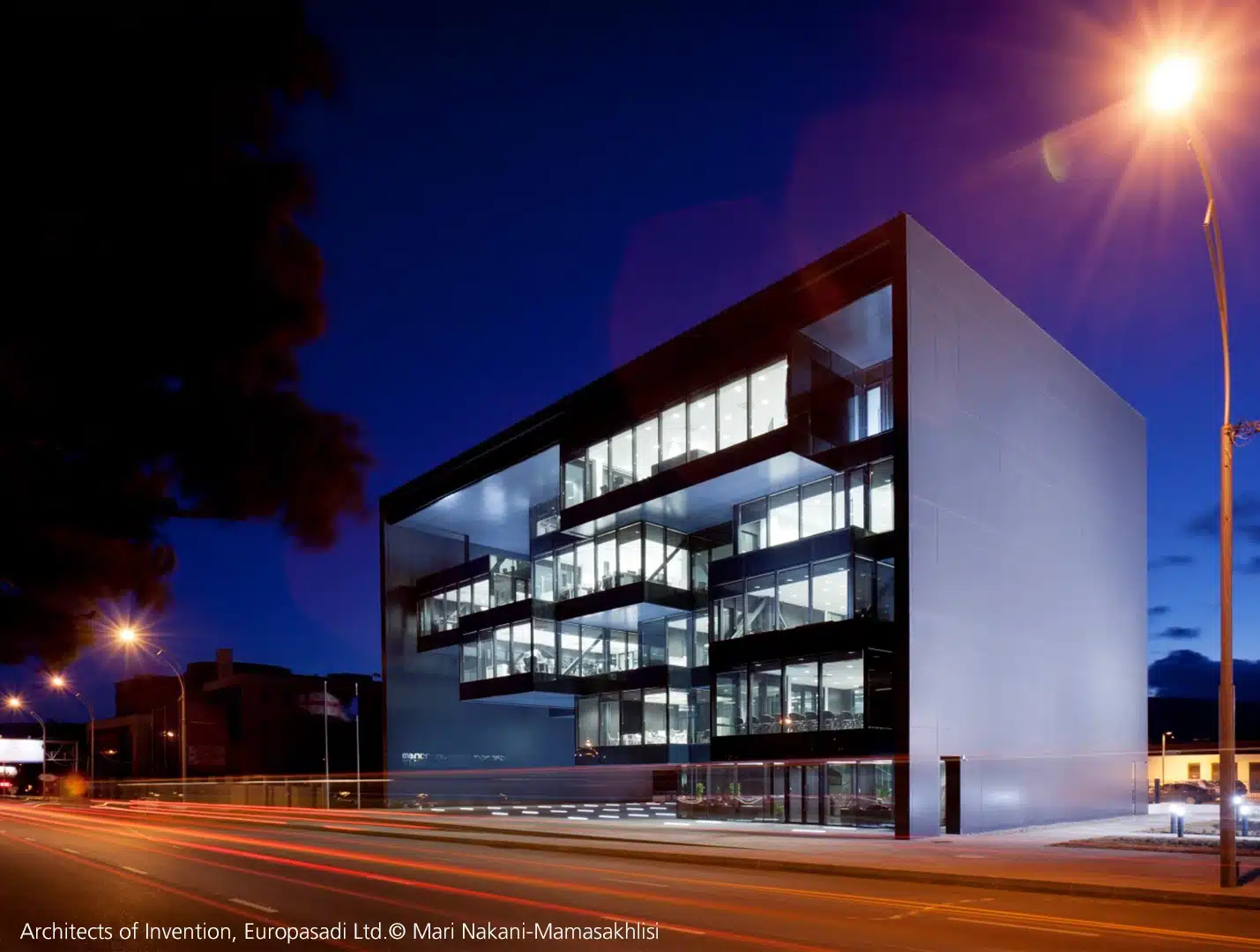
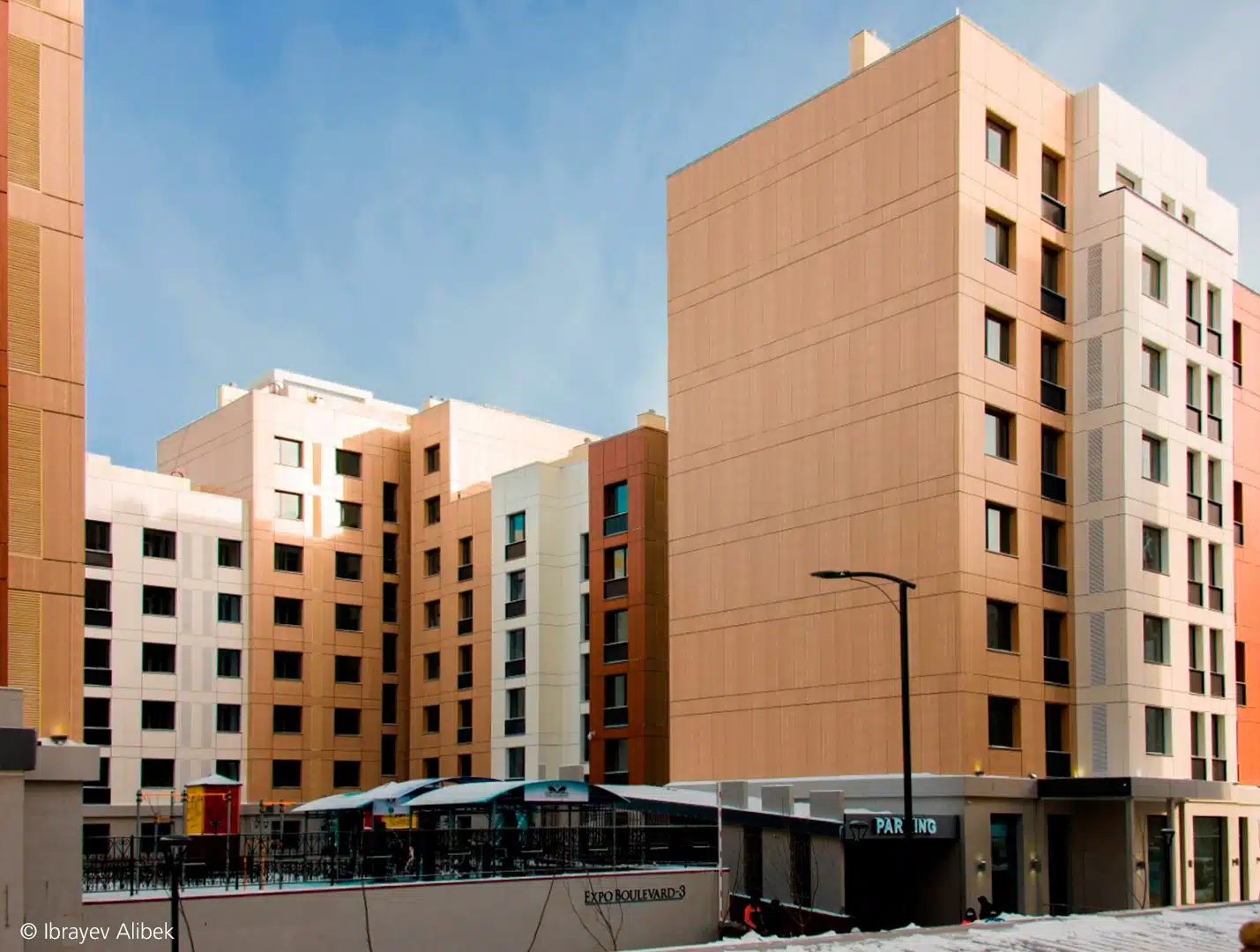
Whether for office buildings, public buildings or residential complexes – Metawall® is the ideal solution for medium and large-scale projects thanks to its continuous production process.
Advantages for your project:
- Economical facade system: Less substructure due to large spans, for quick and easy installation
- Efficient production: Continuous and waste-optimised production process
- Variety of shapes and colors: Diverse design options for every architectural concept
Extensions & additional storeys
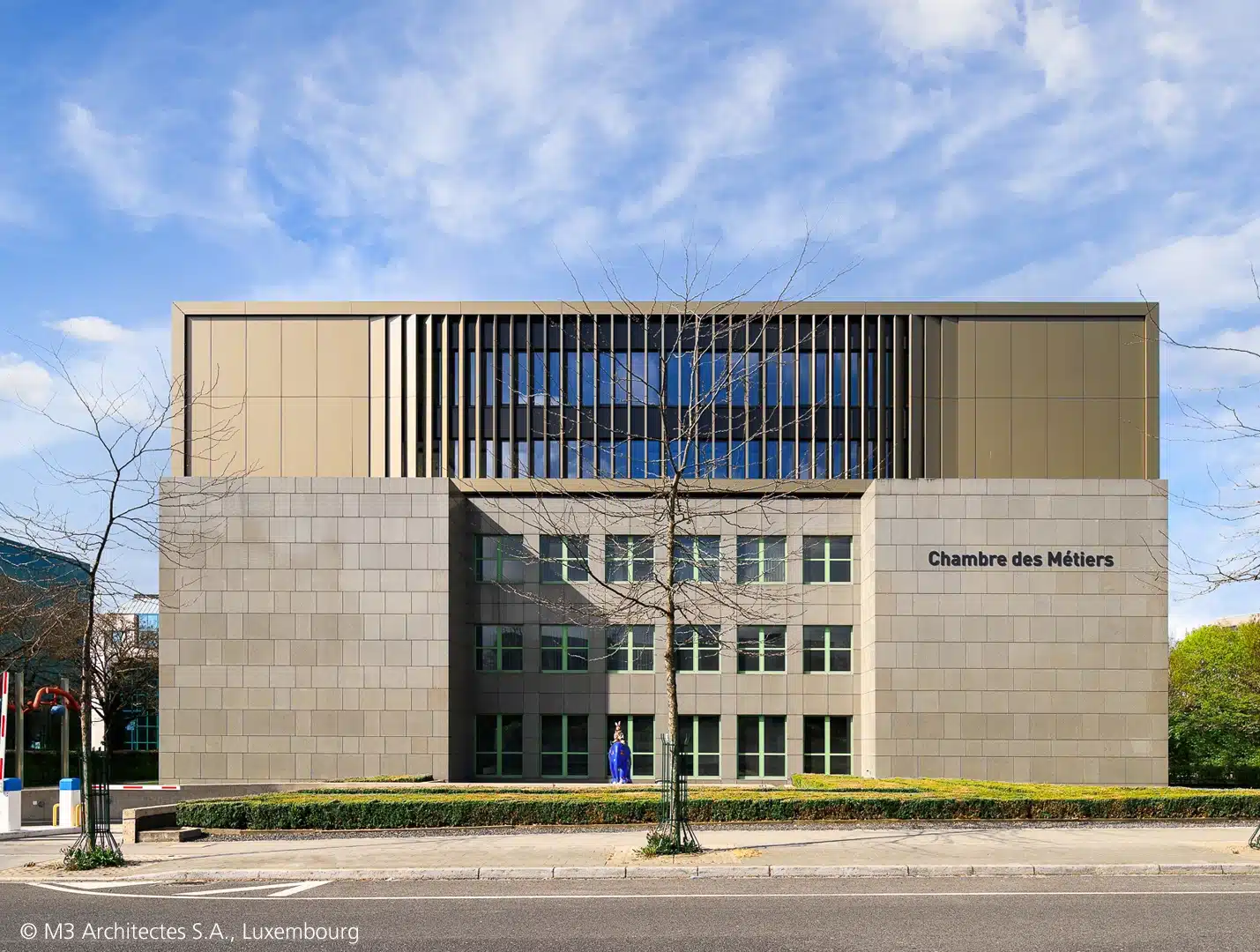
Metawall® is ideal for vertical or horizontal extensions to existing buildings, e.g. in the form of additional storeys, extensions or module additions.
Advantages for extensions & additional storeys:
- Flexible appearance: Can be adapted to the existing façade or as a targeted contrast
- Dry construction method: Perfect for combining with timber, steel or modular construction systems
- Low weight: Unbeatable 5.2 kg/m² – ideal for statically limited load-bearing reserves

Special applications
Thanks to its high rigidity and low weight, Metawall® is ideal for large-area, structurally loaded special applications – for example for cladding pedestrian bridges or as a filler element in post and beam constructions.
Advantages for your project:
- High stiffness: Ideal for large spans
- Low weight: Reduces structural requirements and facilitates installation
- Durability: Exceptional corrosion protection and clever product-specific drainage concept
Product features
Made for today. Designed for tomorrow.
Metawall® combines technical excellence with sustainable material thinking. The result is a future-proofed facade system that is light, stable and waterproofed – and impresses with its intelligent design, long-lasting aesthetics and complete recyclability. A product that not only fulfils the requirements of today, but also takes responsibility for tomorrow.

Metawall® stands for maximum material efficiency and genuine recyclability: made from around 80 % recycled aluminium, fully recyclable without material separation – and thanks to large spans, it can be installed with minimal construction effort. Less material, more impact – both ecologically and economically. Well thought out right from the start: Design for durability meets design for recycling.
Metawall® facade panels are also water and frost resistant, making them ideal for demanding outdoor conditions. Thanks to their intelligent design, Metawall® facade panels ensure permanently reliable drainage and ventilation – without any additional waterproofing. This is the key to a durable, low-maintenance facade construction and emphasises the well thought-out, low-maintenance design.
Another decisive advantage: the exceptionally high stiffness of our aluminium lightweight panel effectively prevents the ‘oil canning’, i.e. the undesirable and unsightly bulging of large-format facade elements. This means that the facade remains permanently flat, straight and elegant – without any visual compromises.
Metawall® is the ideal solution for high-quality and durable façade systems. The material impresses with its low weight – particularly advantageous for buildings with structurally limited load-bearing reserves – and enables quick, easy and efficient installation. Metawall® facade panels can also be used to make subsequent adjustments to the building, such as adding storeys or the building envelope, efficiently and precisely.
Lightly to think. Strongly made.
Metawall® stands for lightweight construction with high performance. The following technical characteristics provide a compact overview of the most important properties of the material – from weight to rigidity. Ideal for precise planning and reliable design of your facade solution.
| Norm | Unit | Metawall® B1 – 10 mm | Metawall® A2 – 15 mm | |
| Panel type | Alu cc 08-03-05 hl / H10
Alu cc 10-03-05 hl / H10 |
Alu cc 10-03-10 hl / H15 | ||
| Thickness | [mm] [inch] | 10 ± 0.2 [~13/32] | 15 ± 0.2 [~19/32] | |
| Thickness of front cover sheet | [mm] | 0.8 / 1.0 | 1.0 | |
| Thickness of back cover sheet | [mm] | 0.5 | 1.0 | |
| Weight | [kg/m²] [lbs/sqft] | 5.2 / 5.7 [1.07 /1.17] | 6.8 [1.39] | |
| Production widths | [mm] | 1000 / 1250 / 1500 / 1600 | ||
| Length | [mm] | max. 7300 | ||
| Technological values | ||||
| Rigidity Longitudinal E·I Transverse E·I |
[Nmm²/m] | 2.13 E+6 1.85 E+6 |
2.26 E+6 1.96 E+6 |
|
| Front cover sheet: Alloy | EN 573-3 EN 515 |
EN AW-5754 H42 | EN AW-5754 H42 | |
| Back cover sheet: Alloy | EN 573-3 EN 515 |
EN AW-5182 H48 | EN AW-5754 H48 | |
| Tensile stress of the cover sheets: Front cover sheet Back cover sheet |
EN 485-2 | [N/mm²] | Rm ≥ 220 Rm ≥ 330 |
Rm ≥ 220 Rm ≥ 280 |
| Proof stress of the cover sheets: Front cover sheet Back cover sheet |
EN 485-2 | [N/mm²] | Rp0.2 ≥ 140 Rp0.2 ≥ 300 |
Rp0.2 ≥ 140 Rp0.2 ≥ 220 |
| Fracture strength | EN 485-2 | [%] | A50 ≥ 7 | |
| Linear expansion coefficient |
EN 1999 1-1 | 2.4 mm/m at 100 K temperature difference | ||
| Aluminium corrugated core | systematically stiffened with an aluminium corrugated core | |||
| Surface | High-quality FEVE and HDP coating systems applied using the coil coating process | |||
| Temperature stability | [ºC] | -40 bis +100 | ||
Metawall® with coil coating
Variety in surface
Metawall® coil coating not only provides excellent corrosion protection, but also offers enormous design freedom. Different colors, textures and surface treatments mean that each project can be customised to create a durable, low-maintenance facade. Available surface options: Matt, decors, metallic & individual RAL colors.
Long-term protection: Thanks to the specially developed coil coating, the facade cladding offer excellent protection against corrosion and environmental pollution.
Perfect processing & precise fitting: Our coil coating technology guarantees a uniform coating of the aluminium cover sheet and exact color fidelity. This ensures a uniform appearance and high-quality finish down to the last detail.
Easy to maintain & durable: Metawall® facade cladding is not only beautiful, but also easy to maintain. The coil coating makes the surface resistant to weathering, soiling and exposure to the elements – a durable solution for any building.
Individual color matching: Choose from a wide range of color options (including special RAL colors) and give your facade the look you want.
| Our general conditions | ||
| Metawall® B1 – 10 mm | Metawall® A2 – 15 mm | |
| Panel type | Alu cc 08-03-05 hl / H10
Alu cc 10-03-05 hl / H10 |
Alu cc 10-03-10 hl / H15 |
| Production width [mm] | 1000 / 1250 / 1500 / 1600 | |
| Our panels are manufactured from three coils in a continuous production process. In order to be able to offer you an economical quotation, 500 running metres of coil length is required for both our manufacturing process and the coil coating process. | ||
| Minimum order quantity per production width [m²] |
1000 mm: 500 m² 1250 mm: 625 m² 1500 mm: 750 m² 1600 mm: 750 m² |
|
| Coating systems | ||
| Coil-Coating / Lacquering | LUMIFLONTM Fluorpolymer coating (FEVE) | HDP (High Durable Polymer) |
| Gloss level | 15 -40 ± 5 units | 30 ± 5 units |
| Coloring | Metallic colors, RAL and NCS, decors etc. – We paint your project in the color of your choice. We would be happy to advise you on your project in collaboration with our coil coaters. | |
| Corrosion resistance | very good | very good |
| Color stability | very good | good |
| Gloss retention | very good | good |
| Weather resistance | very good | good |
Architecturally convincing, technically sophisticated: Metawall® offers an effective solution against oil canning.
Oil canning – not with us
The clever product design of Metawall® prevents uneven surfaces – without any additional reinforcements. For facades with clear lines and a durable, high-quality appearance. However, anyone planning with smooth metal surfaces may also be familiar with the downside: the so-called oil canning.
What is oil canning?
The term describes visible, slightly wavy or bulging deformations on flat metal surfaces. Particularly when exposed to sunlight or from certain angles, the surfaces suddenly appear uneven – almost as if someone had pressed a pillow into the surface. This not only disturbs the appearance but can also raise questions about quality – even if the facade is technically flawless.
What causes oil canning?
The causes are varied, but often a combination of the following factors:
- Thermal expansion: Metal expands when heated – in the case of large, thin sheets, this can quickly lead to visible deformation.
- Insufficient bending stiffness: Material that is too thin or insufficiently stiffened is more prone to wrinkling.
- Installation error: Incorrect fastening points or excessive tension during installation can lead to stress distribution, causing the material to ‘work’.
- Material-related properties: Even small differences in the alloy or manufacturing process can lead to different behaviour – especially with larger formats.
Why is this a problem?
Unlike technical defects, oil canning is often of a purely visual nature. But this is precisely where the problem lies: architecture thrives on aesthetics. Dents, unwanted reflections, and an uneven surface can greatly detract from the overall impression—especially in high-end projects.
Metawall® facade is exceptionally flat, even for large-scale designs

Maximum bending stiffness, especially for large formats – Thanks to the stiffening corrugated core, Metawall® panels have an exceptionally high bending stiffness. Even large facade elements remain permanently flat – regardless of wind loads, temperature fluctuations or point loads.
Low weight reduces tension – The low weight of Metawall® facade panels reduces material-related tension during installation. This reduces the risk of deformation – without any additional reinforcements. For facades that retain their shape permanently.
Thermally resistant sandwich structure – As both the core and the cover layers of the Metawall® panel are made of aluminum, the entire element reacts particularly evenly to temperature changes. This prevents stress differences in the material – and thus the formation of bumps, unwanted reflections and an uneven surface in direct sunlight.
Exceptionally flat in wind and weather – Whether wind pressure, suction or extreme weather conditions: Metawall® panels retain their shape. The high structural rigidity prevents visible changes and preserves the high-quality appearance of the facade in the long term.
Processing & Shaping
Metawall® not only stands for lightness and stability, but also for impressive design freedom. Thanks to its special structure and material properties, Metawall® is extremely flexible to work with – precise, economical and versatile.

Simple processing with standard tools: Metawall® facade panels can be fabricated using standard tools for metal and wood processing – without the need for complex specialised machines. An Alubender and/or a router tabel are sufficient to carry out the typical processing steps – cutting to size, creating edges using a saw cut or V-groove, and making the typical Metawall® edge design.
Easy to install and economical: Metawall® impresses with its high rigidity, which enables larger spans with less substructure – this reduces material and installation costs. The low weight also facilitates handling on the construction site. Quick assembly is possible thanks to dimensionally accurate production; optionally, pre-assembly can be carried out at the factory.
Flexible shaping for creative facade design: Metawall® offers architects and planners maximum design freedom – especially for unusual geometries. Defined milling grooves allow precise bends to be realised, ideal for design-oriented cladding and also complex, three-dimensional formats and special solutions.
Processing instructions & Downloads
We provide extensive technical information for safe and efficient processing:
Product information & Processing
Technical drawings & details
Fire behaviour of Metawall® A2 & Metawall® B1
Approved. Tested. Safe.
Fire protection and approvals are a key issue in facade planning. Depending on the project requirements, our aluminium facade panels offer two safe options with different fire behaviour – but always with maximum reliability.
| Norm | Metawall® B1 – 10 mm | Metawall® A2 – 15 mm | |
| Panel type | Alu cc 08-03-05 hl / H10 Alu cc 10-03-05 hl / H10 |
Alu cc 10-03-10 hl / H15 | |
| General building authority approval (applicable in Europe and Switzerland) | The dimensioning of Metawall® B1 and Metawall® A2 facade cassettes for use with rear-ventilated exterior wall cladding is regulated by the general building approval no. Z-10.3-708. | ||
| ICC-ES AC05 – Proof of adhesion (applicable in the USA) | passed | passed | |
| International fire classifications | |||
| EU (applicable in Europe, Switzerland and Turkey) | EN 13501-1 | B – s2, d0 | A2 – s1, d0 |
| Russiy | GOST 30244-94 | G1 (Flammability) | G1 (Flammability) |
| GOST 12.1.044-89 | non-combustible | non-combustible | |
| USA | ASTM E84 | Tests are currently being carried out | Class A |
| Flame Spread Index | FSI = 5 | ||
| Smoke Development Index | SDI = 0 | ||
| Large fire tests | |||
| USA | NFPA 285 (2012) | passed | |
| NFPA 285 (2023) | Tests are currently being carried out | ||
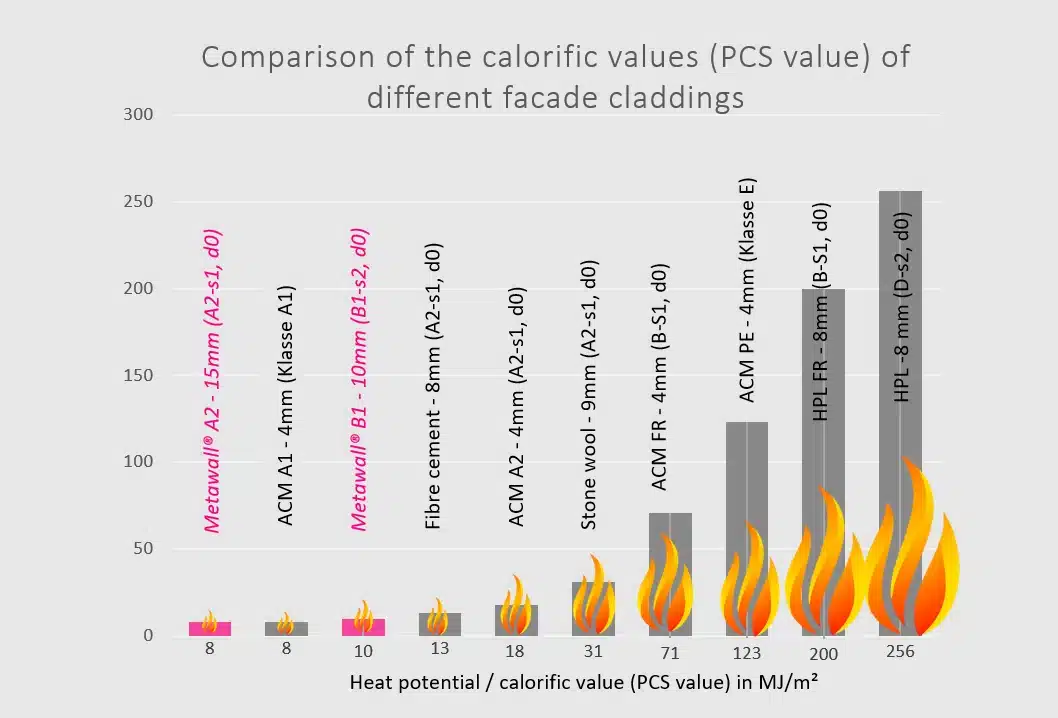
PCS value (calorific value / heat potential)
Determination of the heat of combustion according to DIN EN ISO 1716:2010-11
Tests according to the SBI method (Tests on the fire behaviour of construction products – Thermal exposure to a single burning object for construction products other than floor coverings) according to DIN EN 13823:2020-09.
Metawall® shows excellent properties when comparing fire behaviour in accordance with DIN EN ISO 1716:2010-11. Thanks to its low heat release potential, the product fulfils high requirements for structural fire protection and contributes to compliance with strict safety standards.
Metawall® facade is weather and frost-resistant, low-maintenance and durable
Long-lasting protection thanks to double safety – corrosion-resistant, cleverly drained
Metawall® products are made from highly corrosion-resistant aluminium alloys and are ideally suited for outdoor use due to complete primer protection. Metawall® facade panels offer secure water drainage through a well-thought-out drainage and ventilation concept, regardless of installation direction. The rear ventilation gap allows for pressure equalisation and continuous air circulation, effectively preventing frost damage.
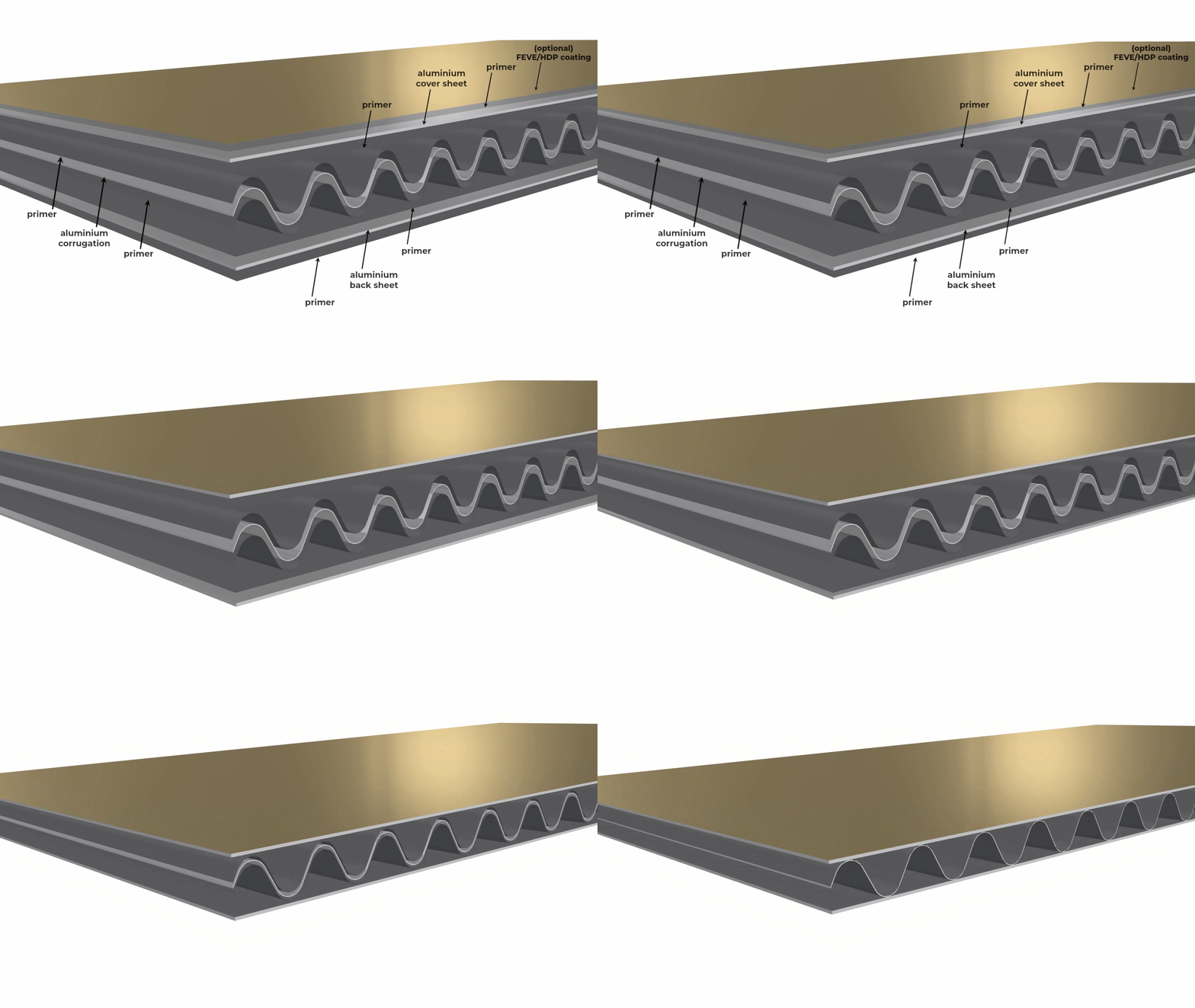
Corrosion protection at all layers: Each aluminium layer – even the corrugated core material – is coated on both sides with a specially developed corrosion protection primer. This protective layer distinctly sets Metawall® apart from other products, where the core material often remains untreated.
Strong adhesion through perfect bonding: The primer not only protects against corrosion, but also forms the essential basis for a durable and stable adhesive bond – a decisive requirement for the longevity of our products.
High-quality alloy for demanding applications: Both cover sheets and the core material are made of 5000 series aluminium alloy with a magnesium content exceeding 2.7%. These alloys are considered particularly corrosion-resistant – even in harsh environments.
Ideal for outdoor use: Thanks to the combination of high-quality alloy and complete primer protection, Metawall® products are ideal for long-term outdoor use, even under demanding climatic conditions.


Safe drainage – no risk from condensation.
Moisture is a natural companion to every building envelope – but not an issue with Metawall®. Our Metawall® facade panels provide permanently functioning drainage and ventilation – all without sealing due to a smart design.
Drainage in every installation position: Whether mounted horizontally or vertically, drainage is always ensured. Condensate can be safely drained at any time, thus preventing frost damage.
Horizontal panel laying – natural drainage: Here, the corrugations flows in a vertical direction and can potentially allow water that penetrates through humidity and condenses due to temperature changes to drain down unhindered.
Vertical panel laying – intelligent design: With horizontally running corrugations, the panel is slightly domed (curved). This automatically directs water to the sides.
Installation instructions: Arrow points upwards: The correct alignment during installation is crucial for proper functioning. The arrow printed on the Metawall® protective film must always point upwards to ensure proper drainage. (Exception for Polifilm protective film!)
Ventilation gap for optimal back ventilation: Additionally, the ventilation gap on the back of the facade panels supports the complete drainage of moisture – for a durable and dry facade system.
Condensate – a physical effect: Warm air can hold more moisture than cold air. As temperatures drop, water vapour condenses – especially when it enters enclosed cavities. Once air penetrates a facade panel, moisture inevitably follows.
Why sealing is not a solution: A complete seal seems reasonable at first glance – but it carries significant risks. Temperature changes create pressure differences between the air trapped in the panel and the surrounding air. These act continuously on the adhesive connection between core and cover sheets and can weaken or even destroy it in the long term.
Sustainably considered. Efficiently done.
The Metawall® facade cladding offers a sustainable solution for modern architecture – environmentally friendly, resource-efficient, and economically convincing. Through material, construction method, and the use of recycled aluminium, it serves as a good example of sustainable lightweight construction.
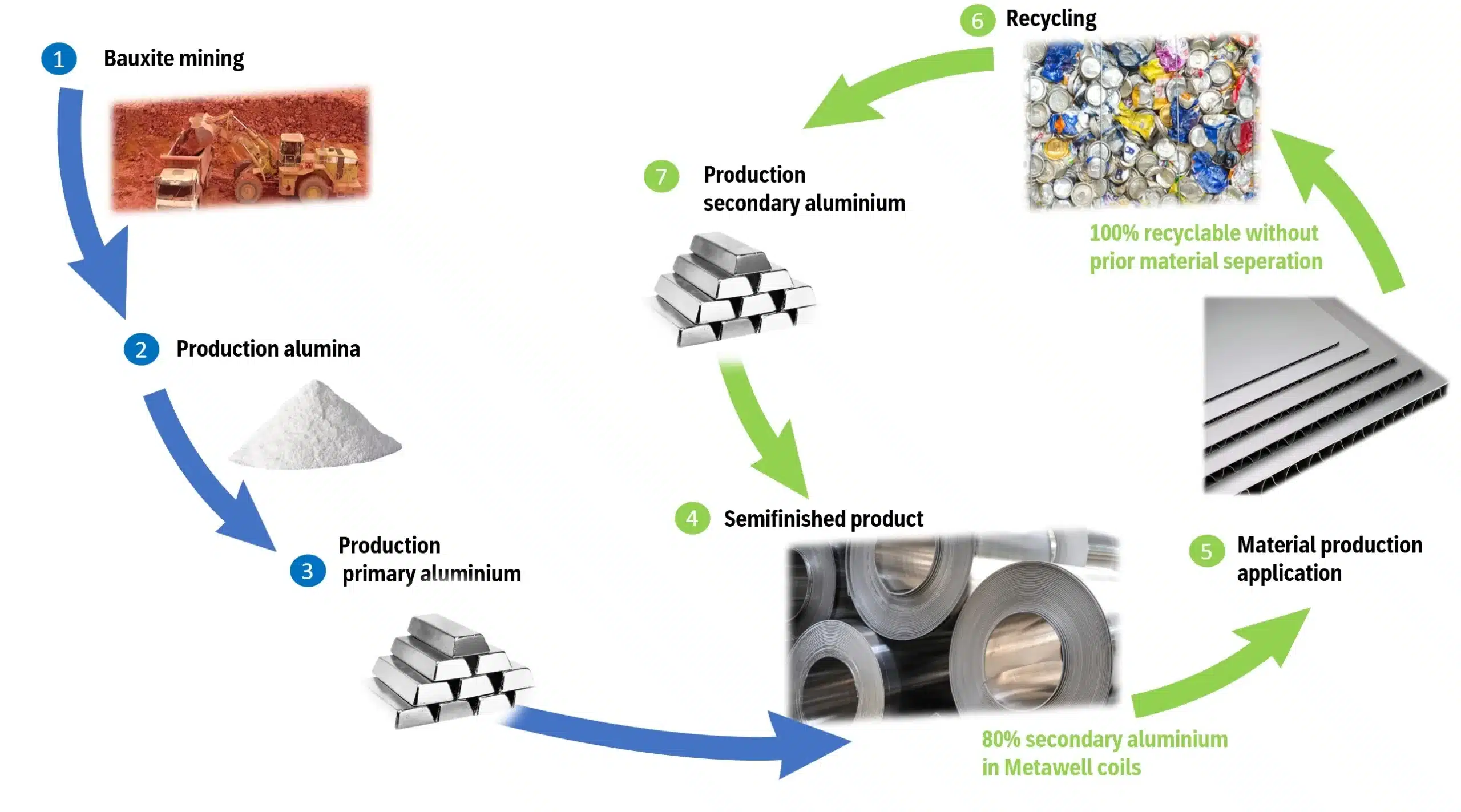
100% recyclable – without material separation: Metawall® products can be fully and easily recycled at the end of their life cycle – without prior separation of materials.
Made from approximately 80 % recycled aluminium: Our products are made of about 80% recycled aluminium – this saves natural resources and reduces the CO₂ footprint.
Less material. More efficiency: Thanks to their large spans, Metawall® facade cladding require less substructure – ideal for large facade panels and economical installation.
Resource-efficient production: Continuous manufacturing ensures a particularly efficient production process with minimal material waste.
Certified sustainability: Metawall® has an Environmental Product Declaration (EPD) in accordance with DIN EN ISO 14025 Type III and EN 15804 – for maximum transparency regarding environmental performance.
Material bank for your building: Aluminium retains its value. At the end of its service life, Metawall® can be sold as a high-quality secondary raw material – your facade thus becomes an investment in the future.

Metawell is a DGNB member because we care about the environment.
As a company, we take responsibility for a sustainable future. With our membership of the German Sustainable Building Council (DGNB), we actively support the development and promotion of environmentally friendly construction methods. Our products and solutions stand for quality, durability and resource conservation – in line with the goals of a sustainable construction industry.
Our EPD: EPD Metawall® A2

Metawall® for drained and back ventilated rainscreen facades
Durable. Low maintenance. High quality.
Drained and back ventilated facade systems offer a modern, technically sophisticated solution for demanding facade design – and with our Metawall® aluminium lightweight panels, these systems can be implemented particularly efficiently and to a high standard.
The technology impresses with a clear separation between insulation and weather protection. This not only allows for design freedom and a long lifespan, but also a well thought-out sustainability concept.
Construction of a back ventilated rainscreen system with Metawall®.
Fixing the substructure: It serves as a structural link between the load-bearing exterior wall and the facade cladding.
Installation of thermal insulation: The insulating materials are precisely fitted between the profiles of the substructure.
Installation of the facade panels: Metawall® facade panels are attached to the substructure – either invisibly with screws or rivets – and provide the external weather protection.

Advantages at a glance
Constructive separation of functions: Thermal, cold and fire protection (insulation) as well as weather protection (facade cladding) are structurally separated from each other – for maximum performance.
Sustainability: At the end of life, the substructure, insulation, and facade panels can be cleanly separated from one another and recycled in a sorted manner.
Cost-effectiveness over the life cycle: Although the investment costs are higher than those of a thermal composite insulation system, they pay off due to lower maintenance, cleaning, and repair costs over the service life.
Simple exchange in case of damage: Individual facade elements can be selectively replaced as needed – a complete renewal is usually not necessary.
Videos
You are currently viewing a placeholder content from YouTube. To access the actual content, click the button below. Please note that doing so will share data with third-party providers.
More InformationYou are currently viewing a placeholder content from YouTube. To access the actual content, click the button below. Please note that doing so will share data with third-party providers.
More InformationYou are currently viewing a placeholder content from YouTube. To access the actual content, click the button below. Please note that doing so will share data with third-party providers.
More InformationYou are currently viewing a placeholder content from YouTube. To access the actual content, click the button below. Please note that doing so will share data with third-party providers.
More InformationYour contact person
| Division | Contact person | Phone | |
|---|---|---|---|
| Facades | Ms. Kriegl | 
|
+49 8431 / 6715-855 |
